Quick Summary
- Doomscrolling is the compulsion to keep scrolling through negative news despite feeling worse, and it’s driven by specific brain mechanisms, not weak willpower
- Your brain’s negativity bias and the dopamine-anxiety feedback loop make alarming content nearly impossible to ignore
- The same variable reward mechanism that makes gambling addictive powers doomscrolling
- Breaking the cycle isn’t about going cold turkey on news, it’s about understanding your brain’s wiring and making small, targeted changes
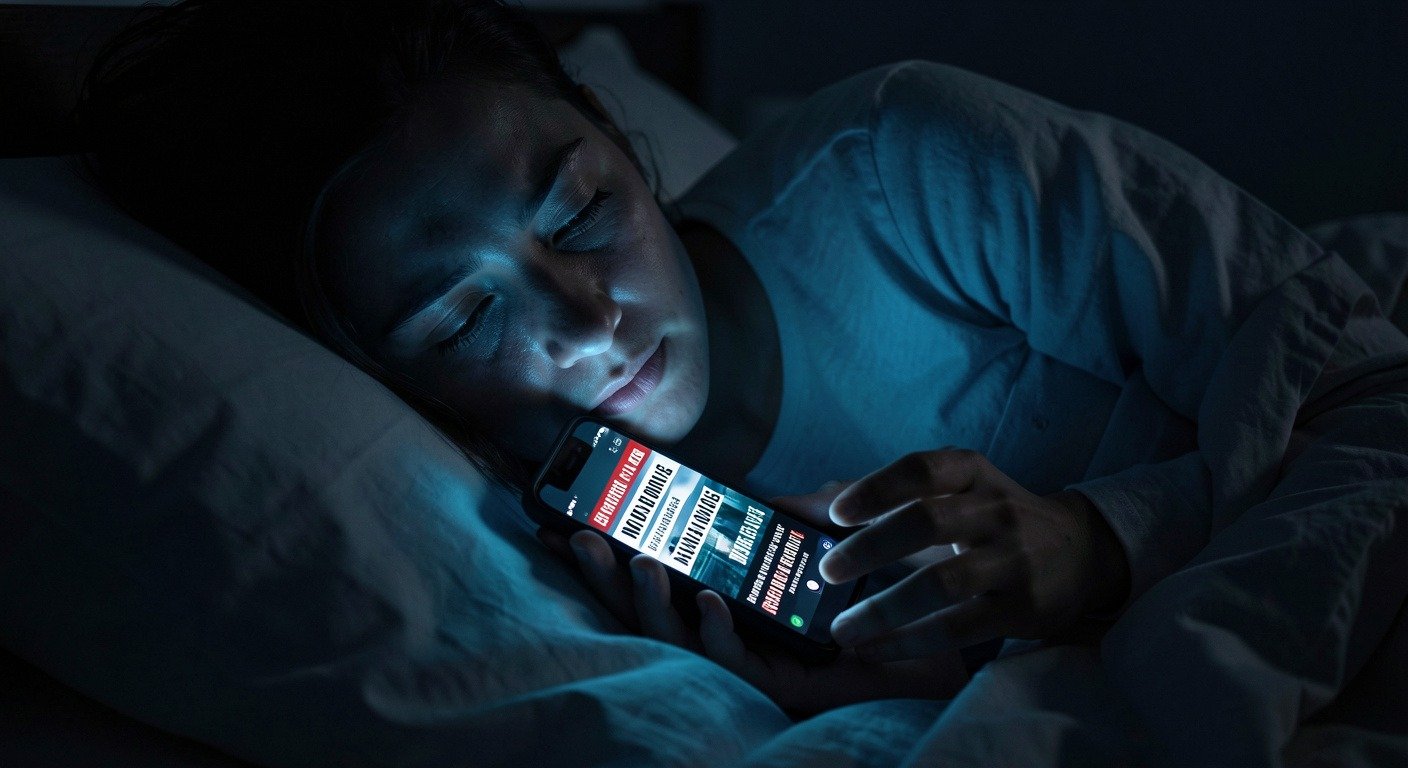
It’s 11:47 PM. You told yourself you’d put the phone down at 10:30. But one headline led to another, and now you’re seven layers deep into a thread about something alarming on the other side of the world. Your chest feels tight. Your jaw is clenched. And you can’t stop doomscrolling.
Your brain isn’t broken. It’s doing exactly what evolution designed it to do: scan for threats and gather information until it feels safe. The problem is that the modern news environment exploits this ancient wiring 24 hours a day.
Why Your Brain Can’t Look Away
The Negativity Bias That Kept Your Ancestors Alive
Your brain prioritizes negative information over positive. This isn’t a design flaw. It’s a survival feature. For most of human history, missing a threat could mean death. The amygdala, your brain’s threat-detection center, fires more strongly and persistently in response to bad news than good news. Researchers at UC San Diego describe this as an evolutionary adaptation that made perfect sense when threats were immediate and physical (UCSD Today, 2025).
The problem? Your brain can’t tell the difference between a predator in the bushes and an alarming headline on a screen three thousand miles away. The same threat-detection circuitry activates. And once it’s on, it doesn’t want to turn off until it has gathered enough information to feel safe.
The Anxiety-Dopamine Loop
When you encounter threatening news, your stress response kicks in. Scrolling for more information becomes a coping mechanism, since your brain treats “knowing more” as regaining control. Each new piece of information provides a brief hit of dopamine, the neurotransmitter associated with reward-seeking.
But the news is still negative. The anxiety returns almost immediately, driving you to scroll again. More anxiety, more scrolling, another brief dopamine hit. Then the anxiety crashes back. This doomscrolling dopamine loop creates a self-reinforcing pattern that mirrors addictive behaviors (UCSD Today, 2025). You’re not weak. You’re caught in a neurological feedback loop that evolved millions of years before smartphones existed.
The Slot Machine in Your Pocket
Doomscrolling operates on variable ratio reinforcement. You never know if the next post will be alarming or reassuring. Sometimes a bad headline appears, sometimes something neutral or hopeful. This unpredictability produces the highest and most persistent engagement of any reinforcement schedule. It’s the same mechanism that makes slot machines addictive (Psychologs, 2025).
Social media algorithms amplify this effect. They surface emotionally charged content at unpredictable intervals. Research published in Science found that false and emotionally negative content spreads significantly farther, faster, and more broadly than true or neutral content (Vosoughi, Roy & Aral, 2018). Your feed is structurally skewed toward alarm before you even open the app.
What Doomscrolling Actually Does to You
The costs aren’t abstract. What starts as staying informed can slide into a negative news addiction without you noticing. Research directly links doomscrolling to increased psychological distress, lower mental wellbeing, and decreased life satisfaction (Satici et al., 2022). Here’s what the habit can do to your brain and body over time.
Your baseline anxiety rises. The more time you spend absorbing negative news, the more your brain treats low-level threat scanning as its default operating state. Sleep quality suffers, since doomscrolling before bed floods your brain with stress hormones when it should be winding down. Attention fragments as your brain becomes accustomed to rapid context-switching between alarming headlines and everything else in your life.
fMRI research suggests that anxious individuals spend roughly 35% longer on negative posts and show about 20% stronger dopamine-related activity in brain reward regions compared to non-anxious individuals. The more anxious you are, the harder the compulsion hits. And the more you doomscroll, the more anxious you become.
Repeated doomscrolling may physically strengthen neural pathways for threat-scanning and anxiety responses. The more you do it, the more automatic it becomes. But neuroplasticity works both ways, and you can also build new patterns.
How to Break the Cycle
The 5-Step Reset Plan
Step 1: Time-Box Your News (5 minutes to set up)
Decide on two specific windows each day for news consumption, 15 minutes each maximum. Set a timer. When it goes off, close the app. Your brain needs to learn that news consumption has a beginning and an end. This single boundary can reduce doomscrolling by breaking the open-ended nature of the infinite feed.
Step 2: Go Grayscale (30 seconds)
Switch your phone to grayscale mode. Colors are engineered to grab attention: red notification badges, bright thumbnails, saturated imagery. Removing color reduces the neurological reward your brain gets from visual stimuli. On iPhone: Settings, Accessibility, Display & Text Size, Color Filters, Grayscale. On Android: Developer Options, Simulate Color Space, Monochromacy.
Step 3: Add Design Friction (2 minutes)
Move news and social media apps off your home screen and into a folder on the last page. Delete them entirely from your phone during high-risk windows like evenings and early mornings. Every extra tap between you and the app gives your prefrontal cortex, the rational decision-making part of your brain, a chance to intercept the impulse before it becomes an action.
Step 4: Replace the Scroll (ongoing practice)
When you feel the urge to doomscroll, have a specific alternative ready. Call one friend. Read one page of a physical book. Step outside for 60 seconds. The brain doesn’t respond well to “just stop.” It responds to “do this instead.” Pick something that engages your hands or body, not another screen.
Step 5: Check In Before You Check the News (10 seconds)
Before opening a news app, ask yourself: “What am I actually looking for right now?” If the answer is reassurance, the news feed is the wrong tool. It’s engineered to keep you anxious and scrolling. Pause and name what you need. Often, the urge to scroll is really an urge for certainty. Naming that can be enough to break the loop.
Breaking doomscrolling habit loops doesn’t require perfection. It requires awareness and small environmental changes that work with your brain’s wiring instead of against it. Each time you catch yourself mid-scroll and choose to close the app, you’re weakening the old pathway and strengthening a new one.

Common Mistakes That Keep You Stuck
Checking news first thing in the morning. Your brain is most susceptible to threat information right after waking. Starting your day with doomscrolling sets an anxious baseline that colors everything that follows. Give yourself at least 60 minutes before opening any news app.
Relying on willpower alone. The compulsion to scroll isn’t a character flaw. It’s a predictable neurological response to a system designed to exploit it. Willpower is a limited resource that depletes throughout the day. Environment design, like grayscale, app placement, and timers, works because it changes the system, not just your intentions.
“Just one more article.” This is the variable reward loop talking. One more article never satisfies the anxiety. It just resets the compulsion. When you catch yourself thinking “just one more,” that’s your cue to close the app.
Going cold turkey on all news. Complete abstinence can increase FOMO and often leads to binge-scrolling later. The goal isn’t to stop consuming news. It’s to consume it intentionally, on your terms, in windows you control.
Wellness disclaimer: This article is for informational and educational purposes only and does not constitute medical or therapeutic advice. If doomscrolling is significantly interfering with your daily functioning, sleep, or mental health, consider speaking with a mental health professional. The strategies discussed are grounded in behavioral psychology and neuroscience research but individual results vary. Always consult a qualified professional for personalized guidance.
Your Turn: Sit With This
When you reach for your phone to check the news, what are you actually trying to feel? Informed? Prepared? In control? Does doomscrolling actually give you that feeling, or does it leave you more unsettled than before?
What would change in your evenings if you put your phone in another room 60 minutes before bed? What would you do with that time instead, and what might you discover about your own mind when the scroll isn’t filling every quiet moment?
Keep Going: Related Guides
- Digital Habit Loops: Why You Check Your Phone 96 Times a Day, the neuroscience behind automatic phone-checking and how to install healthier defaults
- The Boredom-Brain Connection: Why Doing Nothing Makes You More Creative, how discomfort with stillness drives compulsive scrolling and what happens when you let your mind wander
- The Attention Span Crisis: How Screen Switching Fragments Your Focus, the cost of rapid context-switching and how to rebuild deep focus