
By the DDD Team | June 28, 2026
Quick Summary
Your brain has a creativity network called the default mode network (DMN). It activates when you’re doing nothing — staring out a window, waiting in line, lying in bed before sleep. And every time you pull out your phone to fill those empty moments, you shut it down. Research published in Nature Scientific Reports (2025) and decades of neuroscience show that boredom-phone-scrolling-habit/”>boredom is not a problem to solve — it’s a biological trigger for creative thinking, self-reflection, and problem-solving. Constant phone stimulation keeps the DMN suppressed, and over time, that suppression can make it harder to generate original ideas, connect dots between concepts, and even understand your own emotions. This article covers the science of why boredom matters, what phone use does to your creative brain, and five practical ways to bring boredom back without giving up your phone entirely.

Your Brain Has Two Modes — And You’re Only Using One
Neuroscientists talk about two major brain networks that govern how you think. The first is the task-positive network (TPN) — it kicks in when you’re focused on something external: reading this article, replying to an email, scrolling through Instagram, playing a game. It’s your “doing” mode.
The second is the default mode network (DMN) — and it only comes online when you stop doing. When your attention is not anchored to an external task, the DMN activates and starts connecting ideas, replaying memories, imagining future scenarios, and working through unresolved problems. It’s your brain’s background processing system. Researchers sometimes call it the “imagination network” because it’s so central to creative thinking.
Here’s the problem: your phone keeps you in TPN mode nearly every waking minute. Waiting for coffee? Phone. Elevator ride? Phone. Commercial break? Phone. Those small gaps of “nothing” that used to activate the DMN — they’re gone. A 2023 study published in the Journal of Experimental Psychology found that the average person now reaches for their phone within 10 seconds of having nothing to do. That means the DMN barely gets a chance to fire.
And when the DMN stays suppressed for months or years, you don’t just lose daydreaming time. You lose the cognitive machinery that generates insights, solves complex problems, and helps you understand yourself.
What Happens When Boredom Disappears
In May 2025, researchers at the University of the Sunshine Coast published a review arguing that boredom is “the necessary counterbalance to the overstimulated world in which we live.” They weren’t being poetic. They were summarizing a growing body of evidence that small doses of boredom produce measurable cognitive benefits.
A landmark study from the University of Central Lancashire gave participants a deliberately boring task (copying numbers from a phone book) before asking them to generate creative uses for a pair of plastic cups. The bored group came up with significantly more — and more original — ideas than the control group. The researchers’ explanation: boredom signals to the brain that the current situation is unsatisfying, which triggers a search for new mental territory. It’s a creativity ignition switch.
But there’s a deeper layer. A 2025 Nature Scientific Reports study used EEG to map what actually happens in the brain during boredom. They found that boredom is associated with reduced connectivity within the DMN — not because the DMN shuts off, but because the brain is searching, unsatisfied, hungry for meaning. That searching state is exactly what precedes creative breakthroughs. It’s uncomfortable, yes. But discomfort in this case is the signal that your brain is about to do something interesting.
The research is clear on what happens when you never let boredom happen:
- Fewer creative insights. Without DMN activation, your brain can’t make the loose, unexpected connections that produce original ideas.
- Reduced self-awareness. The DMN is also responsible for autobiographical thinking — understanding your own emotions, values, and motivations. Suppress it long enough and you may feel disconnected from yourself.
- Weaker problem-solving. Complex problems often solve themselves when you stop actively thinking about them — a phenomenon called incubation. No boredom, no incubation.
- Increased anxiety. Constant external stimulation keeps your brain in a low-grade state of alertness. Boredom allows it to settle.
The Phone Trap: Why You Can’t Just “Put It Down”
This isn’t a willpower problem. It’s a design problem.
Every app on your phone is engineered to keep you in TPN mode. Infinite scroll feeds remove natural stopping points. Notification badges trigger urgency. Autoplay eliminates the decision to continue. The variable reward system — you never know if the next refresh will bring something good — taps into the same dopamine circuits that make slot machines addictive.
But here’s what makes this particularly insidious for creativity: the phone doesn’t just compete with boredom. It replaces it. The moment your brain would normally shift into DMN mode — a pause between tasks, a moment of waiting — your hand goes to your pocket. You’ve trained yourself to fill every gap. And your brain has adapted by keeping the DMN suppressed, ready for the next external input.
Research from the University of Texas at Austin found that the mere presence of a smartphone — even face-down and silent — reduces available cognitive capacity. Your brain is expending resources to not check the phone. That’s a double hit: not only are you filling boredom gaps with distraction, but even when you try to be bored, the phone in your pocket or on the table is quietly draining the capacity you need for creative thinking.
How to Reclaim Boredom Without Giving Up Your Phone
You don’t need to throw your phone into the ocean. You need to create windows where the DMN can activate — small, deliberate gaps of non-stimulation. Here’s what the research and behavioral science suggest actually works.
1. Create “No-Phone Zones” of Time, Not Space
Spatial rules (“no phone in the bedroom”) are hard to enforce. Temporal rules are easier. Pick two daily windows where you commit to no phone: the first 30 minutes after waking and the last 30 minutes before sleep. During these windows, you’ll naturally encounter boredom — lying in bed, making coffee, eating breakfast — and your DMN will activate. Morning boredom is particularly valuable: research suggests the brain’s creative connections are strongest shortly after waking, before external inputs begin dominating attention.
2. Replace One “Phone Gap” Per Day
Identify one moment each day when you habitually reach for your phone — waiting for the elevator, standing in a line, sitting in a parked car. Instead of pulling it out, do nothing. Let your mind wander. It will feel uncomfortable at first. That’s the signal that it’s working. Over a few weeks, the discomfort fades and the creative benefits start appearing. The University of Central Lancashire study suggests even 10-15 minutes of boredom priming can measurably boost creative output.
3. Use a “Boredom Notebook”
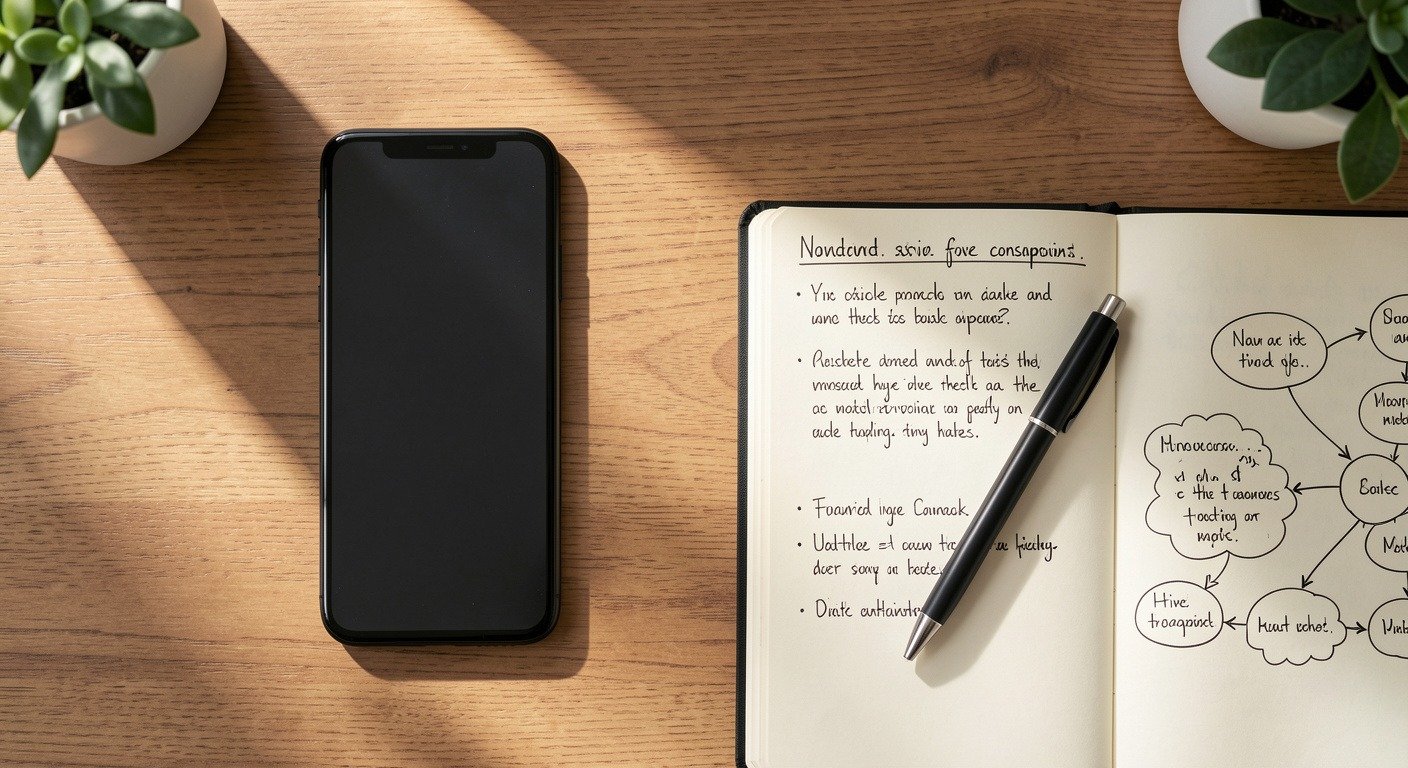
Keep a small notebook (physical, not an app) and when you feel the urge to check your phone during a gap, write down whatever comes to mind. It might be nothing at first — a sentence fragment, a doodle, a memory. Over time, this practice trains your brain that empty moments are for generating ideas, not consuming content. This is essentially DMN training: you’re building the neural pathway that connects boredom to creative output.
4. Remove One App That Eats Gap Time
You don’t need to delete everything. Pick one app that you use almost exclusively to fill empty moments — a social media platform, a news aggregator, a game. Delete it for one week. The goal isn’t to quit the platform forever; it’s to create friction that makes the automatic reach-and-scroll slightly harder. Behavioral economists call this “increasing the choice architecture cost” — and even small friction dramatically reduces mindless use.
5. Schedule Active Boredom
This one sounds absurd, but it works: put “be bored” on your calendar. A 15-minute walk without headphones or phone. Sitting on a bench with nothing to do. Active boredom — where you deliberately choose not to engage with stimuli — is different from passive boredom (where you’re stuck somewhere and frustrated about it). The research shows active boredom produces the strongest creative benefits because you’re not fighting the state; you’re leaning into it.
Try This Today
The next time you’re waiting for something — an elevator, a microwave, a webpage to load — don’t reach for your phone. Just wait. Count to 30. Notice one thing in your environment. Let one thought lead to another. That’s it. You just activated your DMN. Do it once today, and you’ve started rebuilding a neural habit that constant phone use has been suppressing.
The Bigger Picture: What We Lose When We Lose Boredom
There’s something bigger at stake than individual creativity. Boredom has historically been the birthplace of art, philosophy, scientific breakthroughs, and self-understanding. Isaac Newton developed calculus during a period of forced isolation. Einstein credited his theory of relativity to daydreaming about riding a beam of light. Countless writers, artists, and thinkers have described their best ideas as arriving during walks, showers, or idle moments — not during focused work.
We are the first generation in human history that has the ability to eliminate boredom almost entirely. And we’re discovering that this ability comes with a cost. The DMN doesn’t just produce creative ideas — it’s also essential for what psychologists call self-referential processing: understanding who you are, what you value, and what you want. When you never give your brain time to process internally, you risk losing touch with your own inner life.
This doesn’t mean phones are evil or that you should feel guilty about using yours. It means boredom is not a bug in your life — it’s a feature. Protecting small windows of it isn’t about deprivation. It’s about giving your brain the space it needs to do what it does best: connect, create, and make sense of things.
Medical Disclaimer: This article is for informational and educational purposes only. It does not constitute medical advice, diagnosis, or treatment. If you are experiencing significant mental health concerns — including anxiety, depression, or compulsive behaviors — please consult a qualified healthcare professional. Digital wellness strategies can support mental health but are not a replacement for professional care.
Frequently Asked Questions
Is boredom actually good for you or is that just a myth?
It’s backed by real neuroscience. The default mode network (DMN) has been studied extensively with fMRI and EEG, and research consistently shows it activates during unfocused, restful states and is critical for creative thinking, autobiographical memory, and future planning. A 2025 Nature study and the University of Central Lancashire boredom-creativity experiments provide direct evidence that boredom primes the brain for creative output.
How long do I need to be bored for it to help?
Even 10-15 minutes of unstructured mental time can produce measurable benefits for creative thinking, according to the University of Central Lancashire research. The key is consistency — daily small windows are more effective than occasional long stretches.
Can I listen to music or podcasts and still get the benefits?
Not really. Music and podcasts engage the task-positive network (TPN) — your brain is processing external input, which suppresses the DMN. For genuine DMN activation, the time needs to be stimulus-free. A silent walk without headphones is ideal. If silence is uncomfortable, ambient nature sounds (not music with structure) are a reasonable compromise.