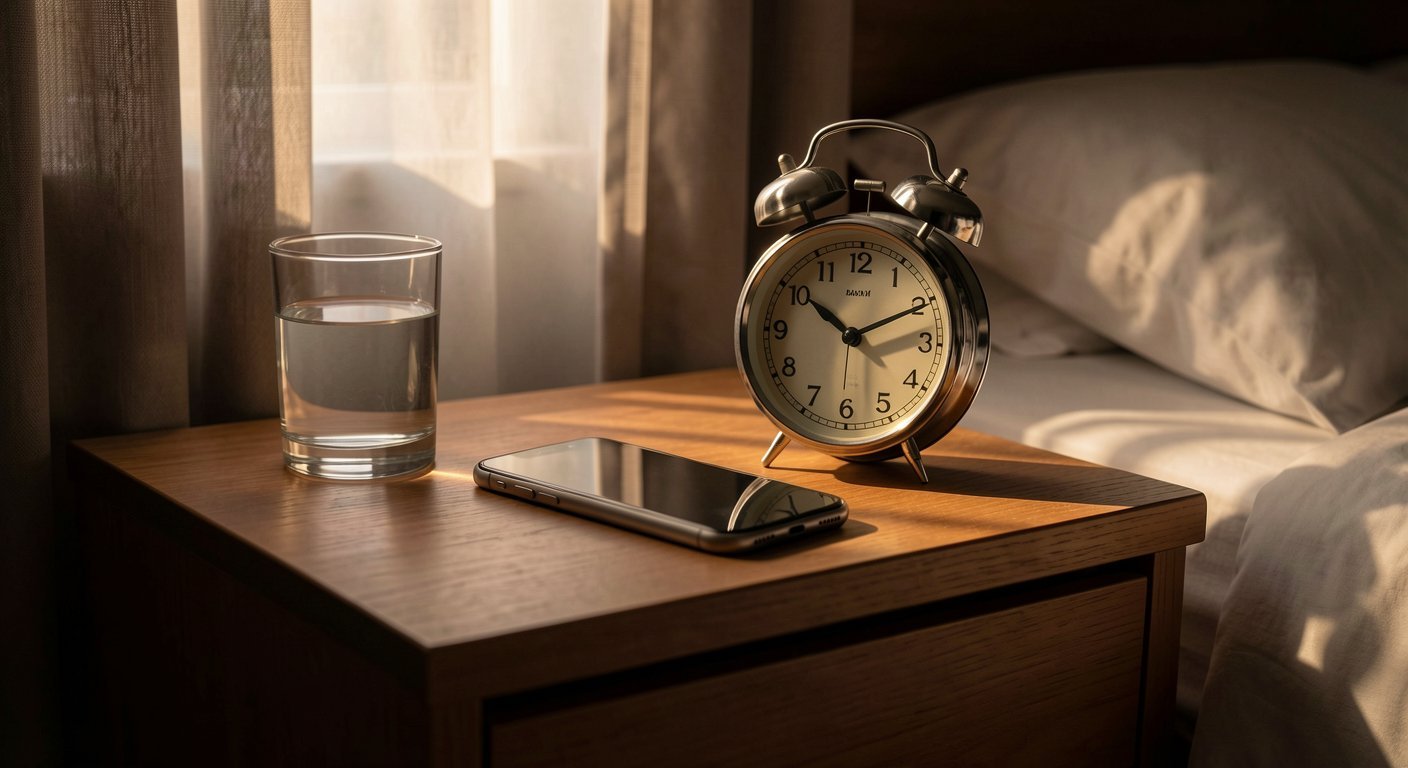
The first thing you touch every morning trains your brain to fail at focus for the rest of the day. Your morning phone habit floods a still-booting brain with unpredictable dopamine stimuli before your prefrontal cortex, which handles attention and impulse control, is even fully online.
Think of your morning brain like a computer that’s just been turned on. It needs to load its operating system and stabilize baseline processes before launching applications. Checking your phone right after waking is like opening 47 browser tabs and launching a video game before the desktop has finished loading. Nothing works right, and the system crashes by noon.
Quick Summary
- Your morning phone habit floods a still-booting brain with dopamine-triggering stimuli before your prefrontal cortex can regulate attention.
- The cortisol awakening response, a 38 to 75 percent cortisol surge peaking 30 to 45 minutes after waking, gets disrupted when you reach for your phone immediately.
- Smartphone notifications operate on a variable-ratio reinforcement schedule, the most addictive behavioral pattern known, training your brain to compulsively scan for rewards all day.
- A phone-free first hour after waking can reset your brain’s default attention mode from reactive scanning to focused, goal-directed thinking.
The Science Behind Your Morning Phone Habit
Your brain doesn’t wake up fully formed. It runs a biological boot sequence that sets the foundation for everything cognitive you’ll do for the next 16 hours. Interrupt it by checking your phone, and you alter the neurochemical architecture governing your attention and impulse control for the entire day.
Your Brain’s Natural Boot Sequence
Within minutes of opening your eyes, your body initiates the cortisol awakening response (CAR), a 38 to 75 percent surge in cortisol that peaks 30 to 45 minutes after waking. This isn’t stress cortisol. It’s your brain’s natural startup hormone, mobilizing energy and preparing prefrontal networks for directed attention.
At the same time, your dopamine system is calibrating. Neurons in the ventral tegmental area set their baseline firing rates, which determines your reward sensitivity for the day. The inputs your brain receives during this window influence where that baseline settles.
What Happens When You Add a Phone
Now consider what checking phone after waking up actually delivers to this still-stabilizing system. Notifications, messages, news alerts. Each one is an unpredictable social reward on a variable-ratio reinforcement schedule, the same behavioral pattern that makes slot machines hard to quit. You never know which check will pay off, and that unpredictability drives compulsive responding. Over time, your morning phone habit runs before conscious decision-making even enters the picture.
Each notification triggers a phasic dopamine spike through the VTA-to-nucleus accumbens pathway, the core reward circuit. fMRI research shows that merely seeing smartphone cues activates frontoparietal attention networks, regions critical for cognitive control. Your phone’s screen is a cue your brain has learned to treat as a reward signal, even when nothing is there.
This is where the problem compounds. Your prefrontal cortex, which filters stimuli and controls impulses, isn’t fully booted during those first waking minutes. The executive function that could say “this notification can wait” is still coming online. Dopamine-driven reward seeking runs unopposed, training your brain into a reactive attention pattern that persists long after you’ve put the phone down.

What Your Morning Phone Habit Actually Costs You
The cortisol awakening response phone users disrupt every morning isn’t just a biomarker. Evening smartphone use elevates morning cortisol and blunts the CAR. One randomized controlled trial found five nights of pre-bedtime smartphone use degraded next-day cognitive performance, with large effect sizes on reaction time.
But the cost goes beyond cortisol. Research on 200 office workers found extended screen exposure strongly correlated with impaired morning attention and reaction time. Even having a smartphone present and on silent impairs working memory. Your brain expends energy inhibiting the urge to check, depleting the same attention reserves you need for everything else.
Then there’s phantom vibration syndrome. Between 41 and 54 percent of young adults report feeling their phone buzz when it hasn’t. It’s classical conditioning. Your brain anticipates notifications so strongly that it produces false buzzes. Morning screen time dopamine spikes reinforce this at the most vulnerable moment of your brain’s daily cycle.
Attention Restoration Theory explains why this matters. Directed attention is a limited resource that fatigues with use. Restoration requires “soft fascination,” gentle stimuli that engage involuntary attention without demanding effort. Think birdsong outside your window, or light moving across a wall at sunrise. Morning phone checking is the opposite: hard fascination that depletes attention reserves before breakfast.
The Morning Reset: What Actually Works
The 5-Step Morning Reset Plan
Step 1: Delay Your First Check (Setup Time: 30 Seconds)
Charge your phone outside the bedroom and use a traditional alarm clock. If you must use your phone as an alarm, place it across the room and do not unlock it. Giving your cortisol awakening response 30 to 45 minutes to complete before introducing external stimuli protects your brain’s boot sequence.
Step 2: Open Natural Light Within 5 Minutes (Time: 30 Seconds)
Open curtains or blinds immediately after waking. Natural morning light helps entrain your circadian rhythm and supports a healthy cortisol awakening response. Even five minutes of daylight signals to your brain that the day has started on its terms, not your phone’s.
Step 3: Build a Low-Dopamine Morning Sequence (Time: 5 to 10 Minutes)
Drink a full glass of water. Do two to five minutes of stretching. Spend five minutes by a window. These activities increase blood flow to the prefrontal cortex without triggering dopamine spikes from digital rewards. They engage soft fascination, the kind of gentle stimulation that restores rather than depletes directed attention.
Step 4: Create a Phone-Free First Hour (Time: 60 Minutes)
Set a rule: no phone, email, social media, or news for the first 60 minutes after waking. A phone free morning routine protects the window when your prefrontal cortex calibrates its attention-control networks. Even a one-week smartphone reduction produces measurable drops in hyperactive symptoms, research suggests.
Step 5: Switch to Intentional Checking (Time: Ongoing)
Before picking up your phone, state: “I am checking [specific thing] for [specific reason].” After you’ve checked that thing, put the phone down. This engages your prefrontal cortex in top-down control, counteracting the automatic dopamine drive. Enable grayscale mode to reduce visual salience, and disable all non-human notifications so your phone works on your schedule.

Common Mistakes That Make It Worse
Common Mistakes That Make It Worse
Using willpower alone. If your phone is by your bed, no amount of discipline overrides the conditioned impulse. Research shows the mere presence of a smartphone, even turned off, impairs cognitive performance. Environmental design beats willpower. Get the phone out of the room.
Replacing phone time with other screens. A phone free morning routine doesn’t mean switching to a tablet or laptop. All screens with notifications or algorithmic feeds produce the same effect: unpredictable variable-reward stimuli hitting a brain that’s still calibrating.
Expecting immediate results. You’ve spent months conditioning your brain to expect morning dopamine spikes from your phone. The neural pathways that drive compulsive checking don’t disappear in three days. Give it two to three weeks of consistent practice. Expect gradual improvement.
Skipping the reflection step. Building a new morning routine without understanding why the old one was harmful invites relapse. When you understand your scattered attention isn’t a character flaw but a predictable biological response, the change stops feeling like deprivation and starts feeling like liberation.
Disclaimer: This article is for educational and informational purposes only. It is not medical advice, diagnosis, or treatment. The neuroscience described is based on peer-reviewed research, but individual experiences vary. If you are experiencing significant attention difficulties, sleep disruption, or compulsive technology use that interferes with your daily life, please consult a qualified healthcare provider or mental health professional.
Your Turn: Sit With This
What would you do with an extra hour every morning if your brain wasn’t already scattered by the time you finished breakfast?
When you reach for your phone tomorrow morning, pause for five seconds and notice what you’re actually feeling. Is it boredom? Anxiety about missing something? Or just a habit you’ve never questioned?
Keep Going
- Phone Notifications Are a Slot Machine in Your Pocket: Why every ping, buzz, and badge trains your brain like a casino game and how to break the cycle.
- Doomscrolling: Why Your Brain Can’t Stop Scrolling Bad News: The neuroscience behind the scroll-and-dread loop and practical strategies to interrupt it.
- Digital Habit Loops: Why You Can’t Stop Checking Your Phone: How cue-routine-reward loops wire compulsive phone checking into your brain’s automatic systems.