
When was the last time you sat in complete silence with nothing in your hands, nothing on a screen, and nowhere to scroll? If you cannot remember, or if the thought makes you slightly uncomfortable, you are not alone. And that discomfort is not a personal failure. It is a signal. Your brain has been trained to avoid empty moments, and your phone has become the escape hatch. The good news: boredom is not a flaw to fix. It is a skill your phone stole from you, and you can take it back.
Most of us have not experienced real boredom in years. We fill every gap, waiting in line, sitting in a parked car, standing in an elevator, the 30 seconds between tasks, with a quick scroll. It feels harmless. It feels like efficiency. But something important gets lost in those micro-doses of stimulation: the mental space where your brain does its deepest work.
Quick Summary
- Constant phone use has eroded the ability to experience boredom, which research shows is essential for creativity, self-reflection, and mental rest
- Smartphones fill every micro-moment of downtime, preventing the default mode network in your brain from activating, the state where deep thinking and problem-solving occur
- Boredom is not a problem to solve but a mental state that leads to idea generation, goal-setting, and emotional processing
- Simple practices like scheduled phone-free time, keeping your phone out of reach, and resisting the urge to scroll during idle moments can restore your capacity for productive boredom
This article is not about shaming you for using your phone. It is about understanding why the boredom phone scrolling habit formed in the first place, what it costs you over time, and how to reclaim boredom as a tool for creativity, focus, and mental clarity, without throwing your phone into a river.
Quick Summary
- Boredom is not an enemy, it activates brain networks tied to creativity, planning, and self-reflection.
- Your phone short-circuits boredom by offering instant novelty, training your brain to need constant stimulation.
- Breaking the boredom phone scrolling habit does not require willpower, it requires friction, awareness, and small practice sessions.
- You can rebuild boredom tolerance with simple exercises that take two minutes or less.
The Loop You Are Stuck In
Here is how the loop works for most people. It is so automatic that you probably do not notice it happening:
- Trigger: A gap opens up. Thirty seconds of nothing. Waiting for a file to download. Standing in line. Sitting at a red light. A lull in conversation.
- Behavior: Your hand moves toward your phone before you consciously decide to check anything. You open Instagram, TikTok, YouTube Shorts, Twitter, or whatever app sits closest to your thumb.
- Short-term reward: Novelty. Something new appears. Your brain gets a small hit of stimulation. The discomfort of doing nothing vanishes.
- Long-term cost: You train your brain to need that stimulation. Over time, boredom feels intolerable. Your ability to sit quietly, think deeply, or let your mind wander shrinks. Creativity suffers. Focus fractures. Your brain’s natural reflective processing, what researchers call the default mode network, gets less and less practice.
This is a classic habit loop: cue → routine → reward. And it runs hundreds of times per day for the average smartphone user. The phone has become a conditioned response to the internal state of boredom, not a conscious choice, but a reflex.
Why It Feels Hard to Stop
If you have tried to “just use your phone less” and failed, you are not weak. You are up against a system that was designed to keep you checking.
Your brain on boredom. When your mind is not focused on a specific task, a network of brain regions called the default mode network (DMN) becomes active. The DMN is involved in autobiographical thinking, future planning, moral reasoning, and creative insight. It is the part of your brain that connects unrelated ideas, replays memories, and generates “aha” moments. Research suggests that many creative breakthroughs happen when the DMN is engaged, during mind-wandering, daydreaming, and yes, boredom.
When you reach for your phone during every idle moment, you suppress the DMN. You never give it room to activate. Over weeks and months, you lose practice with deep, undirected thinking. Your brain becomes dependent on external stimulation to feel engaged.
Dopamine and the novelty trap. Social media apps and short-form video platforms use a reinforcement strategy called variable ratio reward, the same mechanism that makes slot machines compelling. You never know what you will see next. A funny clip? A message from a friend? Bad news? Something that makes you angry? The unpredictability keeps you checking. Each scroll delivers a small dopamine signal, not the “pleasure chemical” that popular media portrays, but a neurotransmitter involved in motivation, learning, and the anticipation of reward. Dopamine tells your brain: “This might be worth repeating.”
Boredom creates a low-stimulation state. Your brain, accustomed to quick hits, interprets that state as a problem to solve. And the fastest solution is the glowing rectangle in your pocket. Each time you use the phone to escape boredom, you reinforce the loop. The next gap feels even harder to tolerate without stimulation.
Attention restoration gets blocked. There is another reason this matters. According to attention restoration theory, your ability to focus is not unlimited, it drains with use. You restore it by spending time in states of “soft fascination”: watching clouds, staring out a window, taking a walk without a podcast, or simply letting your mind drift. When you fill every gap with phone stimulation, you block the restoration process. Your attention battery never recharges. That is why, after a day of constant checking and scrolling, you feel mentally exhausted but cannot point to anything you actually accomplished.

What To Change First
You do not need to eliminate phone use. You do not need to meditate for an hour every morning. You need one small shift: stop treating boredom as a problem to solve.
The first change is not behavioral, it is perceptual. When boredom arrives, your brain sounds an alarm: “Something is wrong. Fix this.” You have been answering that alarm with a phone check for so long that the response feels automatic. But boredom is not an emergency. It is a natural, useful state. Reframing it is the foundation of everything that follows.
Think of boredom as “default mode time.” It is the mental equivalent of idle processing on a computer, background tasks that keep the system healthy. When you let boredom happen, you give your brain permission to connect ideas, process emotions, and generate insight. The discomfort you feel in those first 30 seconds is just a withdrawal symptom from constant stimulation. It fades with practice.
If you want a deeper reset beyond boredom practice, our 7-Day Dopamine Detox Guide walks you through a full week of reducing overstimulation step by step.
Step-by-Step Reset
Here is a practical sequence for breaking the boredom phone scrolling habit. Start at step one. Do not jump ahead. Each step builds on the one before it.
Step 1: Notice the loop for one day
Before you change anything, track it. For one full day, simply notice every time you reach for your phone during a gap. Do not try to stop. Just observe. Count the grabs. Notice what triggered each one: waiting for coffee? Between work tasks? During a commercial? Awareness alone starts weakening automatic habits. Write the number down at the end of the day. Most people are surprised by how high it is.
Step 2: Add friction before you scroll
Your phone is designed to remove every barrier between you and an app. The home screen puts Instagram one tap away. Notifications pull you in before you decide. You can reverse some of that engineering by adding friction. Try one of these today:
- Move social media apps off your home screen and into a folder on the last page.
- Turn off all non-essential notifications. Keep calls and messages. Kill everything else.
- Set your phone to grayscale mode. Color is a reward signal. Removing it makes the screen less compelling.
For a complete walkthrough on reducing your phone’s pull, read our guide on How to Make Your Phone Less Addictive.
Step 3: Practice the two-minute boredom sit
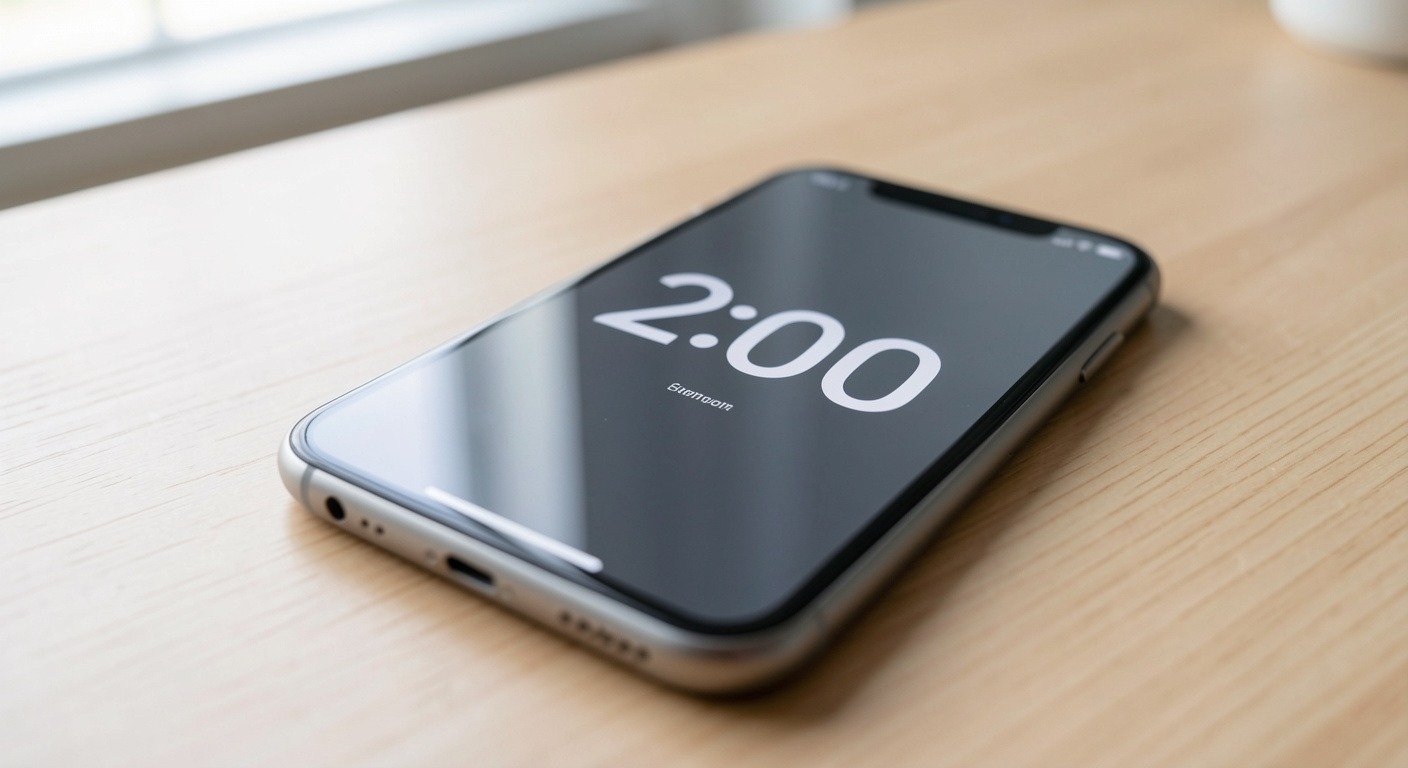
This is the core exercise. Find a quiet moment, waiting for water to boil, sitting in your car before walking inside, between meetings. Set a timer for two minutes. Put your phone face-down, out of reach. Do nothing. No music. No podcast. No reading. Just sit and let your mind go wherever it wants.
The first 30 to 60 seconds will feel uncomfortable. Your brain will scream for stimulation. That discomfort is the withdrawal, not a sign that something is wrong. Let it pass. By the 90-second mark, most people notice the urge fading. By two minutes, your mind often settles into a calmer rhythm. Do this once a day for a week. Then try three minutes. Then five.
Step 4: Build a boredom menu
A boredom menu is a short list of low-stimulation activities that you can reach for instead of your phone. The key: these are not “productive” tasks. They are alternatives that feel easy and require no pressure. Examples:
- Stare out the window and notice three things you have not seen before.
- Doodle on a scrap of paper.
- Fold laundry without any background noise.
- Take a five-minute walk without your phone, just look around.
- Write down whatever thought is currently looping in your head.
- Count how many sounds you can hear right now.
Keep this list somewhere visible, a sticky note on your monitor, a note on your phone’s lock screen, or even a physical index card in your pocket. When boredom hits and the phone urge rises, glance at the menu and pick one item.
Step 5: Use the one-minute rule
When you feel the urge to check your phone, wait 60 seconds before reaching for it. Set a timer if you need to. During that minute, let the urge be there without acting on it. This is not about resisting forever, it is about proving to your brain that the urge will pass on its own. Most cravings for a phone check last less than a minute. By waiting, you teach your brain that the discomfort is survivable and temporary. If after 60 seconds you still genuinely want to check, go ahead. You have already broken the reflex.
Step 6: Carry a pocket notebook
Part of the phone-checking habit comes from a fear of forgetting, a random thought, a to-do item, an idea that flashes through your mind. You check your phone to capture it, and then you get sucked into a feed. A small pocket notebook solves this. When a thought hits during a boredom gap, write it down. Your brain can release it because it is captured. No phone required. No feed trap waiting.
Step 7: Create phone-free zones and times
You do not need to be phone-free all day. Start with one zone and one time block:
- Zone: Keep your phone out of the bathroom and off the dining table. Two small spaces where the habit gets reinforced constantly.
- Time block: Choose a 25-minute window each day, the first 25 minutes after waking, or the 25 minutes before bed, where the phone stays in another room. Boredom will show up. Let it.
For more strategies on reducing constant phone checks, see How to Stop Checking Your Phone Every Few Minutes.
Common Mistakes
When people try to reclaim boredom, they often make the same few missteps. Avoid these and the process becomes much smoother.
- Mistake 1: Replacing phone scrolling with another screen. Switching from Instagram to a podcast, a YouTube video, or an e-book on your phone is not boredom practice. It is just swapping one stimulus for another. The goal is low or zero stimulation, not different stimulation.
- Mistake 2: Trying to go from constant stimulation to an hour of silence. That is like going from zero exercise to running a marathon. Your brain needs a ramp. Start with two minutes. Build slowly.
- Mistake 3: Believing boredom must feel good to be working. It will not feel good at first. Boredom is uncomfortable by design, it signals a mismatch between your desired and actual level of stimulation. The discomfort means you are doing the exercise correctly. Sit with it.
- Mistake 4: Only practicing boredom when you feel motivated. Motivation is unreliable. Schedule boredom sits like you schedule meetings. Put them on your calendar. Treat them as non-negotiable training sessions for your attention.
- Mistake 5: Blaming yourself when the urge to check is strong. The urge is not a character flaw. It is a conditioned response built over hundreds or thousands of repetitions. Beating yourself up only adds shame to the loop. Notice the urge, name it (“there is the phone urge”), and continue sitting.
Try This Today
Here is your single action for today, simple enough that you can do it right now:
Set a two-minute timer, put your phone face-down on the other side of the room, and sit still until the timer goes off. Your mind will wander. You will feel the pull to check something. That is the point. Notice the pull without acting on it. When the timer sounds, you are done. That is it. One two-minute sit. Tomorrow, do it again.
If two minutes feels impossible, start with one. The length matters less than the consistency. What you are building is not endurance, it is tolerance. Your brain needs to re-learn that empty space is safe, not threatening.
Social Media Highlight
“Your best ideas do not come when you are scrolling. They come when you are staring out the window, letting your mind go where it wants.”
Final Reset Reminder
The ability to sit with boredom is not just a nice-to-have skill. It is the foundation of sustained attention, creative thinking, and emotional regulation. When you fill every gap with your phone, you are not just killing time, you are starving the part of your brain that generates insight, solves problems, and understands who you are.
This is not about quitting technology. It is about reclaiming the spaces that technology has colonized, the quiet moments, the waiting gaps, the empty seconds where your mind used to wander freely. Your phone is a tool. Boredom is a door. When you close the door on boredom by reaching for a screen, you never find out what was on the other side.
You do not need to fix your entire relationship with your phone today. Start with two minutes. Let the discomfort pass. Watch what your mind does when it has nowhere to escape. That quiet, wandering space is where your best thinking lives.
If you have been struggling with focus and attention in general, our article on Why You Can’t Focus Anymore explains the deeper attention collapse that constant screen-switching causes, and what you can do about it.
Disclaimer: This article is for informational purposes only and does not constitute medical advice. If you are struggling with severe digital dependency, anxiety, or attention issues, please consult a qualified mental health professional.