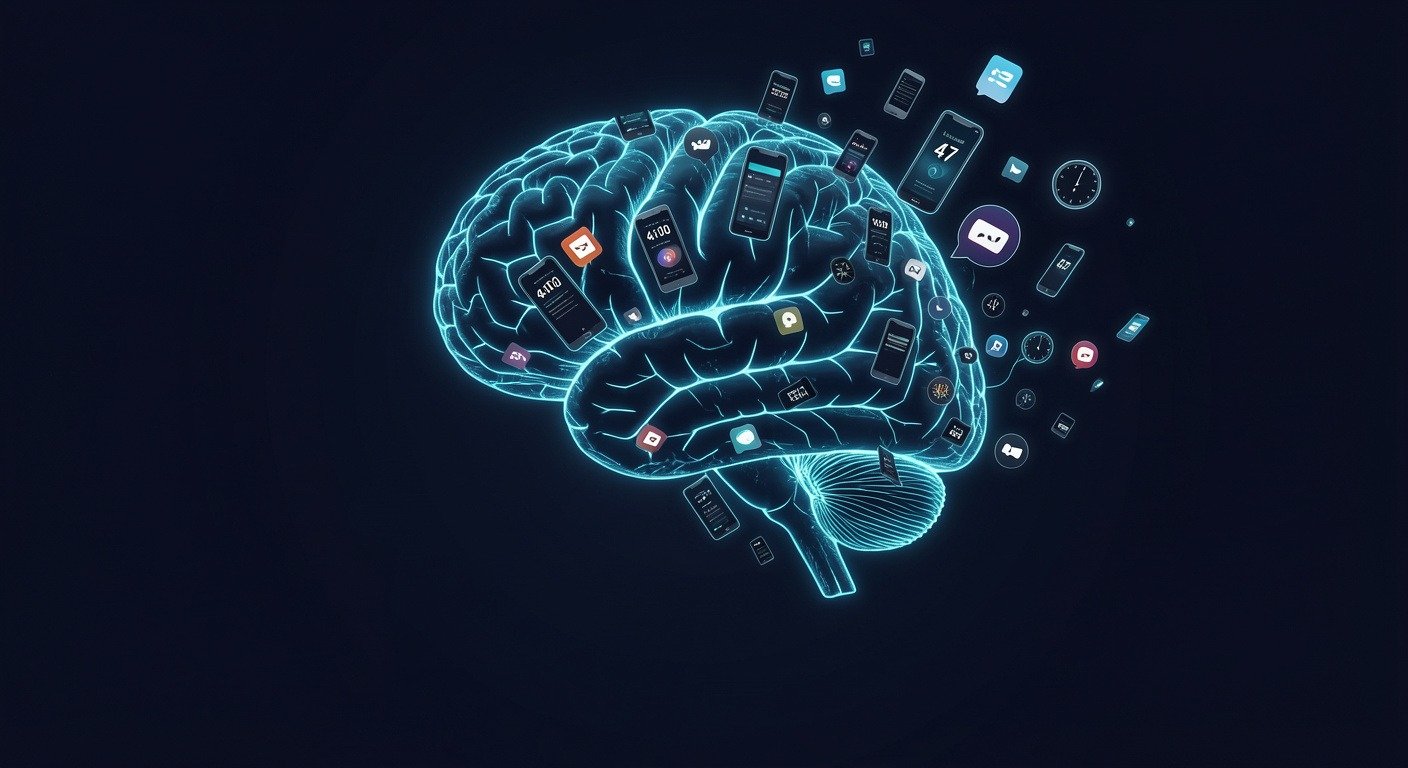
Your phone buzzes. You glance down. A notification from an app you haven’t opened in weeks. You swipe it away, but your eyes are already on the screen. Three minutes later you’re watching a video about a dog that learned to skateboard. You don’t remember opening TikTok.
This isn’t a personal failure. The architecture of your attention has been systematically dismantled , and the data tells a story most people haven’t heard.
In 2004, the average person could sustain attention on a single screen for two and a half minutes before switching to something else. By 2012, that number had fallen to 75 seconds. Today? Dr. Gloria Mark, a professor of informatics at UC Irvine who has been measuring attention spans for two decades, reports that the average is now 47 seconds. The median , meaning half of all measured attention intervals , is just 40 seconds.
That’s not a gradual shift. That’s a collapse.
How We Got to 47 Seconds
The mechanism behind this decline is not mysterious. It follows directly from the design choices embedded in the technology we use every day.
Mark’s research, outlined in her 2023 book Attention Span, tracks attention using computer logging that captures every window switch, every tab change, every interaction. Her data reveals a clear pattern: the more digitally connected we became, the more fragmented our focus grew. Smartphones, social media, messaging apps, push notifications , each layer of connectivity added another vector for interruption.
The platforms themselves are engineered for this. Infinite scroll removes natural stopping cues. Variable reward schedules , the same psychological mechanism that powers slot machines , keep you hunting for the next satisfying post. Pull-to-refresh mimics a lever pull. Auto-play queues the next video before you decide whether you want it.
These are not accidents. They are features.
A 2025 meta-analysis published in Psychological Bulletin, covering 70 studies and nearly 100,000 participants, found that short-form video use , TikTok, Instagram Reels, YouTube Shorts , was negatively associated with attention span and inhibitory control. The effect was moderate but significant: the more compulsively people used these platforms, the harder they found it to sustain focus and resist distraction. Time spent was less predictive than the compulsive nature of the use , the feeling that you can’t stop even when you want to.
The Hidden Cost of Every Interruption
The 47-second average is alarming. But the more damaging figure is what happens after an interruption.
Mark’s research found that after a single distraction , an email notification, a chat message, a quick scroll , it takes an average of 23 minutes and 15 seconds to return to the original task at full depth. And often, people don’t return directly. They go through two intervening tasks first.
Now consider the volume of interruptions. Microsoft’s 2025 Work Trend Index, surveying 31,000 knowledge workers across 31 markets, found that the average employee receives 117 emails and 153 Teams messages per day. That’s roughly one ping every two minutes. Nearly half of all workers , 48% , describe their work experience as “chaotic and fragmented.”
Meanwhile, Reviews.org’s 2024 survey of American phone habits found that the average person checks their phone 205 times per day. That’s once every five waking minutes. Four out of five people check within ten minutes of waking up. Daily screen time has climbed to 4 hours and 30 minutes, a 52% increase from 2022.
If each check costs even a fraction of the 23-minute recovery window, the math becomes unsustainable. Most people are never fully present in any task. Their attention exists in a permanent state of partial engagement , what researchers call “continuous partial attention,” a mode where you are everywhere and nowhere simultaneously.
What Task-Switching Does to Your Brain
The cognitive cost of this fragmentation has a formal name in psychology: the switch cost.
The human brain is not a parallel processor. Despite the popular myth of multitasking, the prefrontal cortex can only handle one attention-demanding task at a time. What feels like simultaneous activity , answering emails while listening to a meeting while checking Slack , is actually rapid sequential switching. Each switch requires the brain to disengage from one set of rules and reorient to another, then reconstruct the mental context it just abandoned.
This is metabolically expensive. Functional MRI studies show that task-switching activates the prefrontal cortex more intensely than sustained single-task focus, burning through glucose , the brain’s primary fuel , at a faster rate. The result is cognitive fatigue that accumulates across the day, leaving you drained without an obvious reason.
Over time, chronic task-switching may actually reshape attentional capacity. A 2009 study by Ophir and colleagues at Stanford found that heavy media multitaskers performed worse on tests of cognitive control , they were more easily distracted by irrelevant stimuli and less able to filter out noise. The researchers concluded that frequent multitaskers may be “sacrificing performance on the primary task to let in other sources of information.”
In other words, the more you practice divided attention, the harder sustained focus becomes.
What You Lose When You Never Get Bored
One of the less obvious casualties of constant digital stimulation is boredom itself , and that may matter more than it sounds.
Neuroscientists have identified a brain network called the Default Mode Network (DMN) that activates when your mind is not focused on an external task. This is the network responsible for daydreaming, autobiographical memory, imagining the future, and making creative connections between unrelated ideas.
Idle moments , waiting in line, staring out a window, sitting with nothing to do , are when the DMN does its most important work. These are the moments that produce sudden insights, solve problems you weren’t actively working on, and generate the kind of creative synthesis that focused thinking alone cannot produce.
Constant phone use eliminates these moments. Every gap in your day , every 30-second pause , gets filled with a screen. The DMN never activates. The creativity and insight it would have generated never arrive.
This isn’t just an individual problem. Researchers and educators are documenting a generation of students who struggle with deep reading, long-form reasoning, and sustained argument , not because they lack intelligence, but because their neural pathways have been optimized for rapid context-switching rather than deep processing. As neuroscientist Maryanne Wolf has written, the “reading brain” is not innate , it must be built through years of practice, and it can be lost if that practice stops.
How to Rebuild Your Attention Span
The science on this is encouraging. Attention is not a fixed trait. It’s a skill , and like any skill, it can be strengthened with deliberate practice.
Here’s what the research supports:
1. Start With Awareness
Before changing anything, spend one day simply noticing your attention patterns. When do you reach for your phone? What triggers the impulse? Most people discover that their phone checking is not driven by real necessity , it’s driven by boredom, discomfort, or the avoidance of a difficult task. Naming the pattern is the first step toward disrupting it.
2. Create Friction
The most effective interventions are the ones that insert a pause between impulse and action. Move your most distracting apps off your home screen. Disable all non-essential notifications. Switch your phone to grayscale , the muted colors reduce the visual reward that bright, saturated interfaces provide. Place the device in another room when you need to focus. Each small barrier disrupts the automatic loop.
3. Practice Single-Tasking
Set a timer for 25 minutes. Pick one task. Close every other tab and application. Work on that single task until the timer goes off. The first few sessions will feel uncomfortable. That’s the point , retraining your brain to tolerate sustained focus without reaching for a distraction.
4. Reclaim Idle Time
The next time you’re waiting for coffee, standing in an elevator, or sitting in a lobby, do not reach for your phone. Let your mind wander. It will feel strange. You may feel a phantom buzz in your pocket , a phenomenon researchers have documented as a genuine tactile hallucination. Sit with it. These moments are where your brain recovers and your creativity resurfaces.
5. Build Focus-Friendly Environments
Mark’s research emphasizes that individual willpower is not the answer , or at least not the whole answer. The modern workplace, with its expectation of instant responses and constant availability, is designed against focus. Push back where you can: block “no-meeting” hours, use email batching instead of real-time checking, and normalize delayed responses.
6. Rest Before You’re Exhausted
Gloria Mark’s research also shows that breaks at natural stopping points , the end of a paragraph, the completion of a sub-task , restore attentional resources far better than breaks forced by exhaustion. When you feel your focus waning, step away briefly. Walk outside. Look at something far away. Let your eyes and mind rest before returning.
What Recovery Actually Looks Like
This is not a two-week fix. Years of conditioned attention fragmentation don’t reverse in days. But the brain’s neuroplasticity , its ability to reorganize and strengthen neural pathways through repeated experience , means that attention can be rebuilt.
Mark’s data shows that even small, consistent changes produce measurable improvement. People who reduce their notification load, who practice single-tasking, who create physical distance from their devices , these people report clearer thinking, less stress, and a greater sense of control within weeks.
The goal is not to abandon technology. The phone is not an enemy , it’s a tool whose default settings happen to work against you. Changing those defaults, and changing how you interact with what’s left, is what reclaiming your attention actually looks like.
You won’t get back to two and a half minutes overnight. But you can get past 47 seconds. And from there, you can go further.
FAQ
Is my attention span permanently damaged?
No. Attention is a skill, not a fixed trait. Neuroplasticity means your brain can reorganize and strengthen attention pathways through repeated practice. Research shows that even small, consistent changes , reducing notifications, practicing single-tasking, creating device-free time blocks , produce measurable improvement within weeks.
Is the “8-second attention span” statistic real?
No. This widely circulated claim , that humans now have shorter attention spans than goldfish , originated from a 2015 Microsoft report citing unreliable data. No peer-reviewed research supports it. The real numbers from Dr. Gloria Mark’s two-decade study show attention spans on screens averaging ~47 seconds , not 8 seconds, but still a dramatic decline from 2.5 minutes in 2004.
How long does it take to rebuild focus?
Improvement begins within weeks of consistent practice, according to Mark’s research. The first few days of single-tasking and notification reduction may feel uncomfortable , that’s the withdrawal from constant stimulation. After two to three weeks, most people report noticeably clearer thinking and reduced stress. Full recalibration depends on baseline usage, but the trajectory is consistently positive.
Do I need to delete all my social media apps?
Not necessarily. The research distinguishes between time spent and compulsive use. If you can engage with social media intentionally , checking it at designated times rather than automatically , that’s different from feeling unable to stop. Start by identifying the one or two platforms that trigger the most mindless scrolling, and remove those first. Keep the ones that genuinely connect you with people.
Medical Disclaimer: This article is for informational and educational purposes only and does not constitute medical advice. The content is not intended to diagnose, treat, cure, or prevent any condition. If you are experiencing significant difficulty with attention, focus, or impulse control that affects your daily functioning, please consult a licensed healthcare professional. Do not disregard professional medical advice or delay seeking it because of something you have read here.