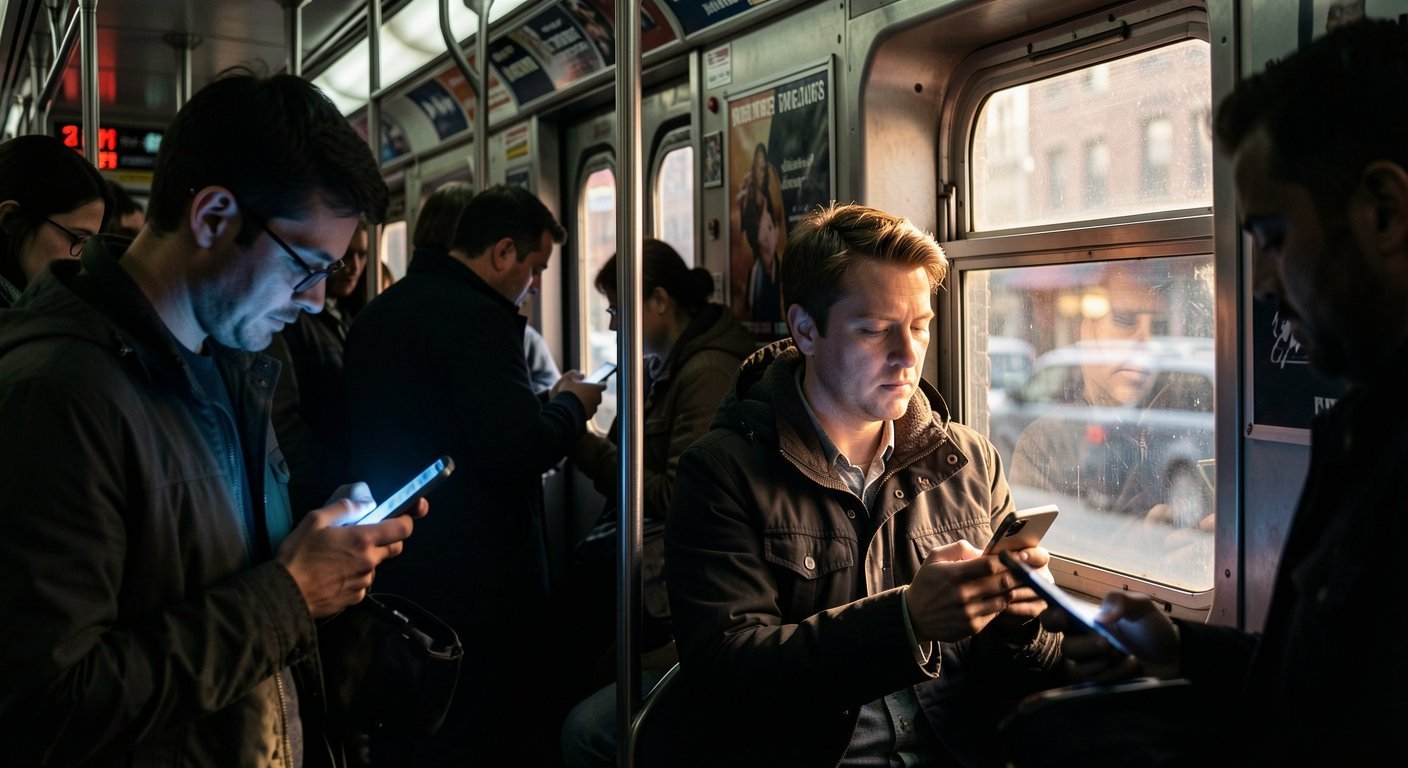
Twelve hours and thirty-six minutes. That is how long the average American spends staring at screens every day, according to Reviews.org’s 2025 screen time study. Americans check their phones 205 times daily. Now factor in New York City: the longest average commute in America, a tech workforce of over 300,000, and a culture that treats constant availability as a virtue. This NYC screen time report breaks down what that means for the people who live here.
Quick Summary
- Americans average 12 hours and 36 minutes of daily screen time across all devices, with 205 phone checks per day (Reviews.org, 2025)
- NYC residents face unique screen-time amplifiers: the longest US commute (40 min avg one-way), a dense tech workforce, and public transit culture that defaults to phone use
- Compared to LA and Chicago, NYC’s screen-time patterns are shaped by subway scrolling rather than car culture, creating different challenges and solutions
- NYC has more digital detox resources than most cities, including Framework NYC deep work pods, the Digital Detox NYC Meetup, and walkable phone-free neighborhoods
The Numbers: How Much Screen Time Are We Actually Logging?
The Reviews.org 2025 survey found an average of 12 hours and 36 minutes of daily screen time across all devices. That is down from 16 hours and 10 minutes in 2024, but still represents the majority of waking hours. Adults aged 18 to 24 average 11.3 hours, with nearly half on mobile devices (TechRT, 2025).
No city-level screen time survey exists for New York City specifically. But what we do know about NYC suggests the real number for residents may be higher than the national average.
NYC-Specific Factors: Why This City Hits Different
The Commute Problem
New York City has the longest average commute of any major US city at roughly 40 minutes each way (US Census ACS data). Most of that time is spent on subways and buses where phone use is the default. Two 40-minute commutes add 80 minutes of what researchers call “captive screen time”: phone use that happens because there is no better option. Over a work week, that is nearly 7 hours of additional screen time that car commuters do not accumulate. You cannot scroll through Instagram while driving. You absolutely can while riding the N train.
Tech Industry Density
Silicon Alley employs over 300,000 people in tech-related jobs. These workers spend 6 to 8 hours per day on computers as a baseline, screen time that most personal-use surveys do not count. When a developer logs 8 hours of work screen time and then comes home to 4 hours of personal screen time, the real daily total approaches 14 hours. More tech workers per square mile means more residents whose jobs require screens, which bleeds into off-hours habits.
Remote Work and the Blurred Boundary
NYC’s high concentration of knowledge workers also means a high rate of hybrid and remote work. When your office is your apartment and your commute is 30 steps to the desk, the boundary between work screens and personal screens disappears. There is no subway ride to decompress, no walk between meetings. Just one continuous screen session from morning coffee to bedtime scrolling.
How NYC Compares: Los Angeles and Chicago
Los Angeles residents face a different pattern. LA’s longer car commutes mean less mid-transit phone time (you cannot scroll while driving), but more at-home evening screen time. The drive itself becomes a forced screen break that NYC subway riders do not get. Chicago is closest to NYC: similar urban density, robust public transit, and a growing tech sector, but with slightly shorter commutes. Each city’s infrastructure shapes its residents’ screen habits in ways most people never notice.
What NYC Experts and Resources Are Available
The same density that creates the problem also creates the solution. Framework NYC in Manhattan offers private, distraction-free deep work pods for breaking the screen loop. The Digital Detox NYC Meetup group organizes regular phone-free social events where leaving your phone behind is the norm. For teenagers, The Luddite Club in Brooklyn runs phone-free meetups that make digital detox feel like community, not deprivation.
The Urban Density Paradox
Here is the contradiction at the heart of this NYC screen time report: density amplifies phone use (more QR codes, more digital ads, more social pressure to be available), but density also provides the best antidote (walkable neighborhoods, abundant parks, world-class museums). The same person who spends 80 minutes scrolling underground can walk out of the station into a city more interesting than anything on their feed. The question is which side of that equation they choose.
What NYC Can Do About It: A Three-Step Reset
Step 1: Reclaim Your Commute (Immediate)
Download podcasts or audiobooks before you leave home and put your phone in your bag for the entire subway ride. Carry a paperback. The goal is not to stare at a wall. The goal is to replace phone stimulation with stimulation that does not come from an algorithm.
Step 2: Audit Your Total Screen Time (This Week)
Screen Time (iOS) and Digital Wellbeing (Android) only track your phone. Add up your work computer hours manually for one day. Most people underestimate their total by 2 to 3 hours. Knowing the real number is uncomfortable, but it is the only way to make an informed decision.
Step 3: Join One Offline Community (This Month)
Sign up for one Digital Detox NYC Meetup event or book one Framework NYC session. The social accountability of showing up where phone-free is the norm will do more for your habits than any app, timer, or willpower hack.
Common Mistakes That Make Screen Time Worse
Don’t count only your phone. The phone is the device you notice. But work computers, tablets, and TVs add hours. Track everything for one day. Don’t try to quit cold turkey. Going from 12 hours to zero in a weekend sets you up for relapse. Start by eliminating captive screen time, the subway scrolling you do not even enjoy. Don’t replace phone scrolling with laptop scrolling. The goal is less screen time total, not moving the same behavior to a bigger screen.
Your Turn: Sit With This
If you added up every minute you spent looking at a screen yesterday (phone, work computer, TV, tablet), what would the total be? Higher or lower than the 12.5-hour national average? And if it is higher, what are you not doing with those hours that you wish you were?
- Screen Time and Sleep: The Blue Light Myth vs. What Actually Matters: how screen time really affects your rest
- How to Stop Doomscrolling: Science-Backed Strategies: practical tools for breaking the scroll
- Digital Detox Guide: What It Is, Why It Matters: the complete overview of digital wellness
Wellness Disclaimer: This content is for informational and educational purposes only and does not constitute medical advice. Screen time habits exist on a spectrum. If you experience significant distress or impairment from digital device use, consult a licensed mental health professional.
— SEO Metadata: – Focus Keyword: NYC screen time report – SEO Title: NYC Screen Time Report: Hours We’re Losing to Phones – Meta Description: This NYC screen time report examines how the longest US commute, Silicon Alley’s 300K+ tech jobs, and always-on culture amplify digital overload, plus local resources that actually help. – URL Slug: nyc-screen-time-report – Primary Category: Digital Detox – Tags: NYC screen time, digital health NYC, screen time statistics, phone addiction, digital detox, New York City