Reading Time: 8 Minutes
Walk into any pharmacy and you will find an aisle of products promising to save your sleep from blue light. Glasses for $20. Glasses for $80. Screen protectors, light bulbs, night-mode apps, and specialized lamps, all built on the same premise: blue light from your screens is destroying your melatonin, wrecking your circadian rhythm, and the only fix is to block it. The blue light sleep science tells a more complicated story.
The blue light industry is worth an estimated multi-billion dollar globally. It grew from a real scientific finding, one that is genuine and well-replicated in controlled laboratory conditions. But somewhere between the lab and the marketing department, the evidence got stretched until it barely resembled what researchers actually found. This article separates what the science shows from what the industry sells.
Quick Summary
- Blue light does suppress melatonin, but the effect in real-world screen use is measured in single-digit minutes of sleep delay, not hours.
- The biggest controlled study to date, a 2023 Cochrane Database of Systematic Reviews randomized trial, found no significant difference in sleep quality between blue-blocking glasses and clear placebo lenses.
- What actually keeps you awake is cognitive engagement, the content on your screen, not just the color of its light. Brightness and proximity matter more than wavelength.
- Practical changes that work: dim your screen, switch to warm light at night, and stop using your phone 30 to 60 minutes before bed, regardless of what color the screen is.
Important Disclaimer
This article is for education and information only. It does not provide medical advice, diagnose sleep disorders, or replace professional healthcare guidance. If you experience chronic insomnia, excessive daytime sleepiness, or sleep problems that affect your daily functioning, please speak with a qualified healthcare provider. Do not delay seeking professional support because of something you read here.
Where the Blue Light Panic Came From
The story starts with real science. In the early 2000s, researchers at Brown University and elsewhere identified a new type of photoreceptor in the mammalian retina: intrinsically photosensitive retinal ganglion cells, or ipRGCs. Unlike rods and cones, which handle vision, ipRGCs exist to tell your brain what time it is. They contain a photopigment called melanopsin, which is most sensitive to light around 480 nanometers , right in the blue part of the visible spectrum.
When blue light hits these ipRGCs, they send a signal along the retinohypothalamic tract to your suprachiasmatic nucleus, or SCN, a tiny cluster of neurons in the hypothalamus that acts as your brain’s master circadian clock. The SCN then signals the pineal gland to suppress melatonin production. This is genuine, well-established circadian biology, confirmed across dozens of studies and multiple species.
The leap from that finding to “your phone is destroying your sleep” is where the science got stretched. The original lab studies used bright, sustained light exposures, often hundreds of lux for extended periods, delivered directly to the eye under controlled conditions. A smartphone screen held at arm’s length delivers far less light energy to the retina, and people do not stare at their phones continuously for two hours in a dark room the way lab protocols required. This is where the blue light melatonin myth starts to unravel: the mechanism is real, the dose from everyday devices is just much smaller than popular media suggested.
What Controlled Studies Actually Show
By 2025, dozens of experimental studies had examined the effect of evening screen use on sleep, and the results are notably consistent: blue light matters, but far less than most people have been led to believe.
A 2023 Cochrane systematic review, the gold standard in evidence synthesis, analyzed 17 randomized controlled trials on blue-light filtering lenses. The findings were inconsistent: three studies showed improvement, three showed no difference. The overall evidence was rated very low-certainty for sleep outcomes. For total sleep time, the effect was negligible. To put that in perspective, the difference between scrolling your phone with Night Shift on versus off might be the time it takes to brush your teeth.
This finding is often misinterpreted. It does not mean blue light does nothing. It means that in the complex, multifactorial reality of human sleep, the spectral composition of your screen light is a minor variable compared to everything else going on. The question does blue light affect sleep has a nuanced answer: yes, it does, at a measurable but clinically small level that most people will never notice in their daily lives.
The Cochrane Database of Systematic Reviews Trial: What Happens When You Actually Control for Placebo
If you really want to know whether something works, you need a placebo control. That is what a 2023 randomized controlled trial published in Cochrane Database of Systematic Reviews did. Researchers assigned 120 adults to wear either authentic blue-blocking glasses or identical-looking clear placebo glasses for the four hours before bedtime, every night, for four weeks. Sleep was measured objectively using wrist actigraphy, a validated method that tracks movement to estimate sleep onset, duration, and quality.
The result: there was no significant difference between groups on any sleep outcome. Sleep quality, total sleep time, sleep onset latency, and next-day alertness were all statistically indistinguishable between those wearing real blue blockers and those wearing clear glass. The largest blue light sleep study conducted to date found that blocking blue light produced no measurable benefit beyond placebo.
What Actually Disrupts Your Sleep: Three Factors That Outweigh Blue Light
If blue light is not the main culprit, what is? Research points to three factors that collectively explain most of the sleep disruption associated with bedtime screen use.
Screen Brightness and Proximity
The total light energy reaching your retina depends on both brightness and distance. A phone held eight inches from your face at maximum brightness delivers far more melanopic lux, the metric that matters for circadian disruption, than the same phone at minimum brightness held at arm’s length. Studies consistently show that dimming your screen has a larger effect on melatonin suppression than shifting its color, because total light intensity matters more than spectral composition for the ipRGC response.
Psychological Engagement
This factor alone likely outweighs blue light by a wide margin. Your brain cannot transition from sympathetic (alert, aroused) to parasympathetic (calm, restorative) dominance while it is processing novel, emotionally charged content. Algorithmic feeds, short-form video, and notification-checking create intermittent spikes of arousal: dopamine hits, cortisol micro-bursts, and orienting responses to novelty. The content you consume right before bed carries into your pre-sleep cognitive state, and pre-sleep cognitive activity is one of the strongest predictors of insomnia, regardless of what color the screen was.
Time Displacement
The simplest and largest effect: screens keep you awake longer. A 2023 analysis of objectively measured smartphone use in over 65,000 individuals found that each hour of in-bed phone use was associated with approximately 50 minutes of lost sleep. Time displacement accounted for an estimated 85 percent of the total sleep deficit. The color of the light matters far less than the simple fact that the phone is in your hand when you should be asleep.
5 Simple Fixes That Actually Work (and Cost Nothing)
- Dim Your Screen
Reduce your phone brightness to the lowest comfortable level after sunset. Total light intensity matters more for circadian disruption than color temperature. - Hold It Further Away
Double the distance from your eyes to your phone and you reduce retinal light exposure by a factor of four, regardless of the color. - Switch to Warm Light at Night
Use Night Shift or Night Mode after sunset. The effect is small but real, and it costs nothing. Just do not expect it to solve your sleep problems on its own. - Stop Scrolling 30 to 60 Minutes Before Bed
If you make one change from this entire article, make it this one. The single largest effect on your sleep is not the color or brightness of your screen. It is the simple fact that you are still awake looking at it. - No Phones in the Bedroom
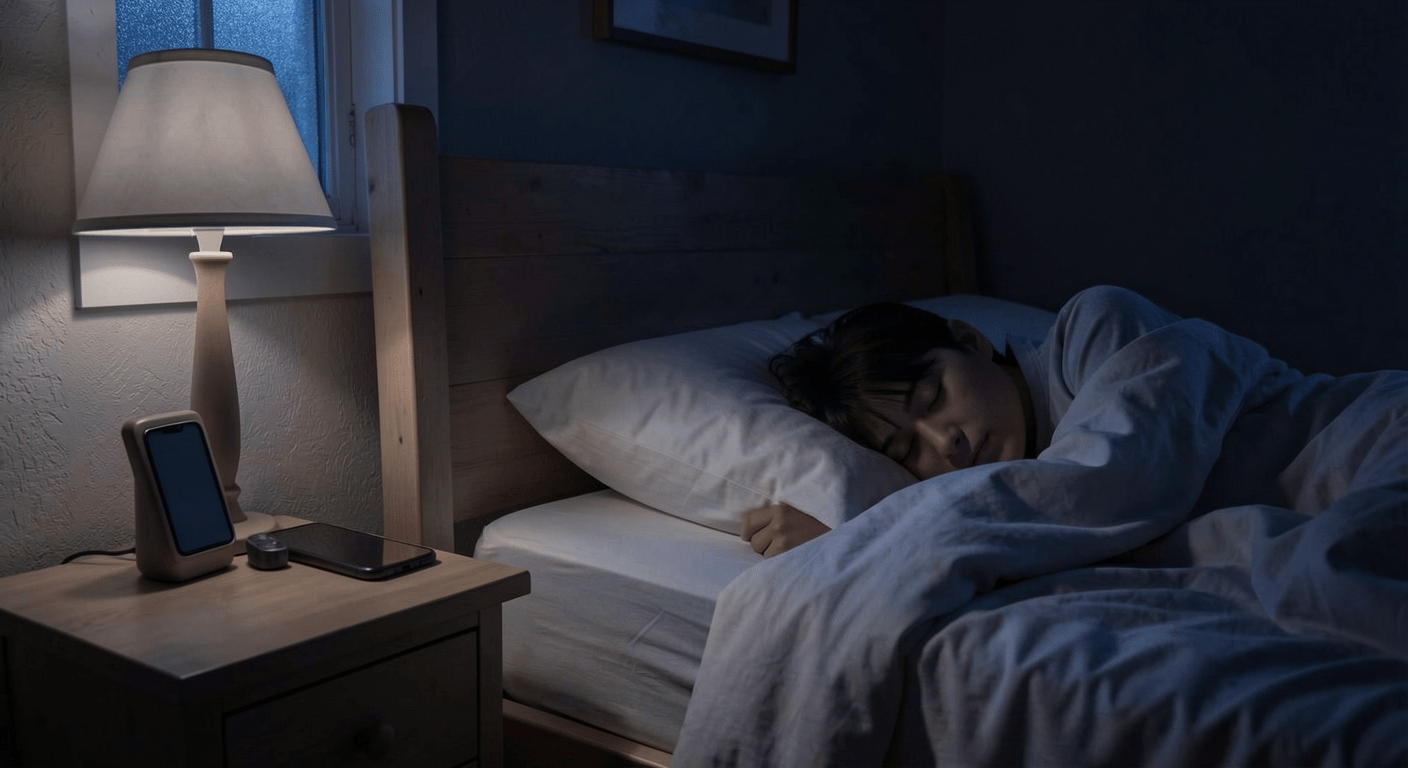
Charge your phone outside your bedroom. Buy a ten-dollar alarm clock. If your phone is not in the room, you cannot scroll it, and if you cannot scroll it, you will sleep.
Common Mistakes People Make About Blue Light and Sleep
- Buying expensive blue-blocking glasses expecting them to fix chronic insomnia. The evidence does not support this. Save your money.
- Assuming Night Shift makes it safe to scroll until 2 a.m. A warm screen is still a screen, and the content that keeps you cognitively aroused does not care what color temperature your display uses.
- Ignoring brightness while obsessing over color. Dimming your screen does more for your circadian rhythm than filtering blue light, because melanopic lux is driven primarily by intensity, not wavelength.
- Treating blue light as the only variable that matters for sleep. Sleep hygiene involves many factors: consistent bedtime, a cool dark room, exercise, caffeine timing, stress management. Blue light is one small piece of a much larger puzzle.
The Bottom Line
The blue light story is not wrong. It is just incomplete. Yes, light around 480 nanometers can phase-delay your circadian rhythm and suppress melatonin through the ipRGC-to-SCN pathway. That is real, replicated science. But the magnitude of this effect from consumer devices in real-world conditions is modest: a few minutes of sleep delay, not hours. Overstating it does not help people sleep better. It just sells more glasses.
If you want better sleep, stop worrying about the color of your screen light. Dim your phone. Put it down earlier. Keep it out of the bedroom. These three changes cost nothing, are supported by evidence, and will do more for your sleep than every pair of blue-blocking glasses ever sold combined. The blue light sleep science is clear: the wavelength matters. It just matters much less than you have been told.
Reflection
How many of your evening habits were built around the idea that blue light is the enemy? If you traded your blue-blocking glasses for a 30-minute phone curfew tonight, what would change?